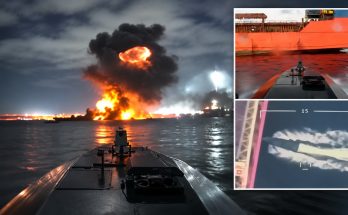

No navy, defense ministry or shipping intelligence firm has confirmed viral reports that a missile struck a heavily defended warship, leaving the claims unverified.
The reports spread online with grainy video clips and broken audio. They say an incoming weapon got through several layers of defense and hit a major warship in contested waters.
Key details are missing: the ship’s type, its country, the weapon used, and whether it suffered holes in the hull, fires or casualties. Naval commands, defense ministries and maritime intelligence services have said nothing publicly, according to the original report.
Without clear commercial satellite images, official damage reports or verifiable tracking data, naval and electronic-warfare analysts said, viral battle reports should not be treated as fact.
Modern warships rarely operate alone. They use layered defenses. Long-range radar and surveillance aircraft spot incoming missiles hundreds of miles away and direct long-range interceptors against them. Missiles that get past face medium-range interceptors, jammers that blind missile seekers, and launchers that fire chaff and flares to draw them away from the ship.
The last line of defense is rapid-fire cannons and small missiles that try to destroy a leaking missile seconds before impact.
No defense is perfect, ship designers say. Missile speed and size, flight just above the waves, sea clutter, the radar horizon and computer processing delays all affect whether a ship survives.
Attackers increasingly try to overwhelm ships by firing many weapons at once, including cheap drones, decoys, cruise missiles and steeply diving anti-ship ballistic missiles. The goal is to use up the ship’s computing power and its stock of ready missiles so one warhead gets through.
Within hours of the first reports, anonymous channels shared clips said to show explosions, listing ships and firefighting. Open-source researchers showed that several of the clips were recycled from past naval accidents, tanker fires or training exercises.
Navies usually stay quiet during and after a clash, analysts said. Commanders limit radio and radar emissions and focus on accounting for crew and controlling damage long before public affairs offices speak.
Independent observers said only clear satellite radar or optical images could confirm whether the ship was hit. The images would need to show it sailing under its own power, under repair in port, or with scorch marks. They could also show that interceptors downed the weapon harmlessly.
A confirmed hit would have major consequences for navies worldwide. Investigators would look at whether radars were degraded, jamming failed, targeting software was overloaded, interceptors malfunctioned or ammunition ran low.
Navies and missile makers are in a constant race. Anti-ship missiles now use stealth shaping, automatic target recognition and supersonic dashes, and ballistic versions dive at hypersonic speeds. Navies are answering with better jammers, testing shipboard lasers, and expanding networks that let ships fire interceptors using tracks from distant aircraft.
For now, the reported strike exists only in unverified online posts. Allied naval groups continue regular patrols, and naval logistics commands report no emergency diversions, according to the original report.
Until wreckage, official casualty notices or clear satellite images appear, analysts said, the claim should be treated as rumor, not confirmed fact.